
Nobody warned me about the joint pain.
Or the anxiety that showed up out of nowhere at 47. Or the brain fog so thick some mornings I would walk into a room and completely forget why I was there. Or the way my skin changed texture almost overnight. Or the mood swings that felt so out of character I started wondering if something was seriously wrong with me.
I thought I knew what menopause was. Hot flashes and missed periods. That was the whole picture, right?
It is not. Not even close.
So if you are somewhere between 45 and 60 and your body feels like it is doing things you did not agree to, this article is for you. I am not going to soften it. I am just going to tell you what is actually going on.

Perimenopause vs menopause — the difference matters
Most women think of menopause as one event. It is not. It is a whole chapter, and perimenopause is the part nobody talks about.
Perimenopause is the years leading up to your last period. It can start in your early 40s. For some women it starts at 38. It can last anywhere from two years to ten years. Your hormones, mainly estrogen and progesterone, start fluctuating wildly during this time. Not declining steadily. Spiking and crashing. That unpredictability is why the symptoms can feel so chaotic.
Menopause itself is one specific moment — twelve consecutive months with no period. That is it. Everything before that is perimenopause. Everything after is post-menopause.
The reason this matters is that most of the worst symptoms happen during perimenopause, not after. So if you are in your mid to late 40s and feeling completely unlike yourself, you are probably in the thick of it right now.

The symptoms nobody prepared me for
Hot flashes are real. But they are not the whole story. Here is what else estrogen decline does to your body.
Brain fog is one of the most common and most dismissed symptoms. Estrogen supports the production of acetylcholine, a chemical your brain uses for memory and focus. When estrogen drops, acetylcholine drops with it. The result is forgetfulness, mental slowness, and a frustrating inability to find words you know perfectly well. This is not early dementia. It is hormonal. For most women it improves after menopause stabilizes.
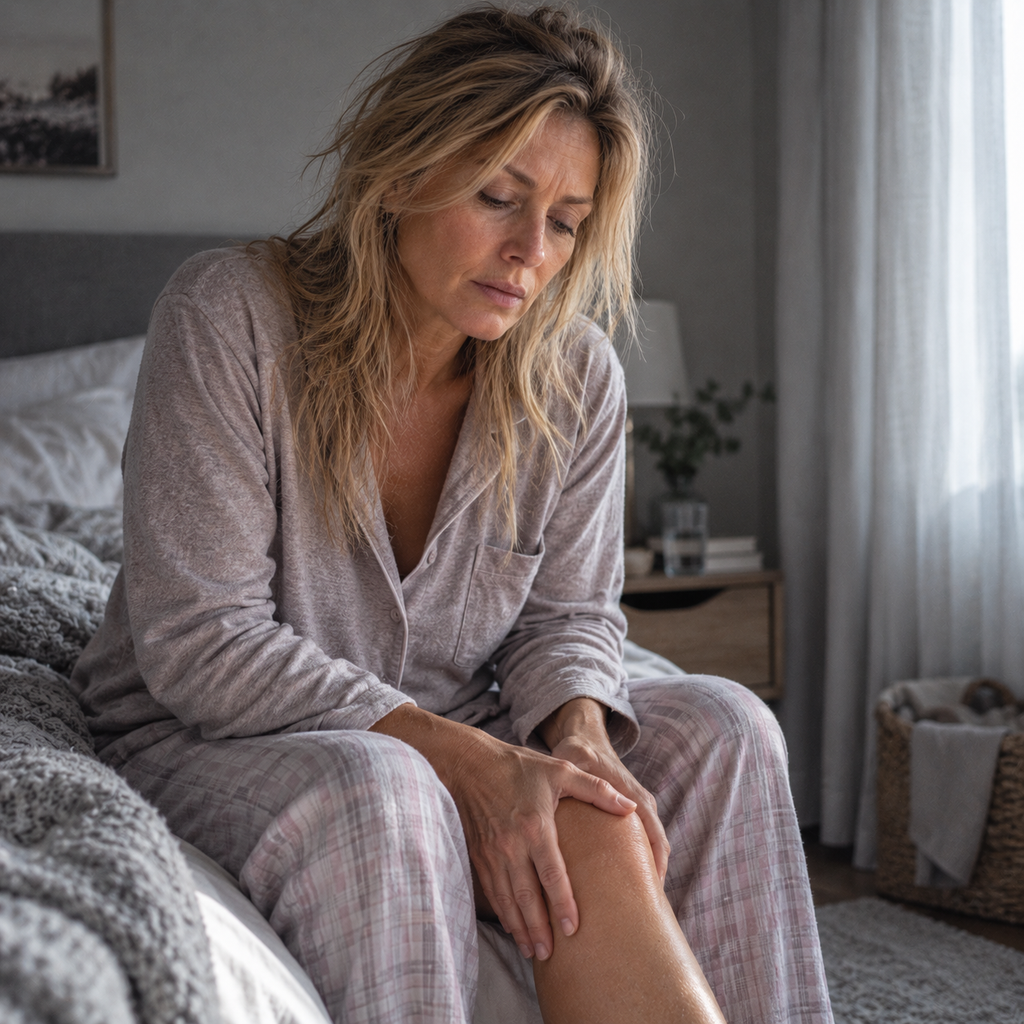
Joint pain surprises almost everyone. Estrogen has an anti-inflammatory effect in the body. When it drops, inflammation rises. Your joints feel it. Knees, hips, fingers, wrists. Morning stiffness that takes an hour to shake off. Pain that moves around and does not quite make sense. Nobody warned me about this one and I spent two years thinking something was wrong with my joints specifically.
Anxiety. This one knocked me sideways. I had never been an anxious person. Then somewhere around 47 I started waking up at 3am with my heart racing for no reason. Estrogen regulates serotonin and GABA, both of which calm the nervous system. When estrogen crashes, your baseline anxiety level rises. The world feels slightly more threatening than it used to. Small stressors feel enormous. This is biology, not a breakdown.
Skin texture changes. Estrogen stimulates collagen production and keeps skin hydrated from within. When it drops, skin gets thinner, drier, and loses that plumpness. You might notice it around the jawline first, or in how your skin feels when you touch it. Less bounce. More crepe-like texture around the neck. This happens fast in the first few years after menopause.
Sleep disruption. Progesterone has a natural sedative effect. As it declines, falling asleep gets harder. Staying asleep gets harder. Night sweats wake you up. And then the sleep deprivation makes every other symptom worse. It is a cycle.
Weight distribution changes. Even if your weight stays the same, where it sits shifts. Fat moves toward the middle. This is partly estrogen, partly insulin sensitivity changing with age, and partly the muscle loss that happens after 50. None of it is your fault. But it is real.
Vaginal dryness and bladder changes. Less talked about, very common. Lower estrogen means less moisture in vaginal tissue. It also weakens the bladder. More urgency, more frequent infections. A lot of women suffer through this quietly. You do not have to.
What actually helps

No single answer works for everyone. But here is what has the most evidence behind it, and what I found useful personally.
Hormone replacement therapy (HRT) is the most effective treatment for moderate to severe symptoms. It got a bad reputation from a 2002 study that has since been widely reanalyzed and largely walked back. For most women under 60 who start HRT within ten years of menopause, the benefits outweigh the risks. Talk to your doctor, not a forum. Get the conversation.
If you are not ready for HRT, or do not need it, lifestyle matters more than most women realize.
Sleep first. Protect it aggressively. Cool room, no alcohol within three hours of bed, consistent wake time even on weekends. Alcohol specifically worsens night sweats and disrupts the deep sleep where most hormonal regulation happens.
Strength training two to three times a week reduces joint inflammation, builds the muscle mass that estrogen used to protect, and improves insulin sensitivity. You do not need a gym. Bodyweight exercises at home three times a week is enough to make a measurable difference.
Protein at every meal. Aim for 25 to 30 grams per meal. Your muscles need it. Your brain needs it. Most women going through perimenopause are under-eating protein and wondering why they feel weak and foggy.
Manage stress the way you manage your diet. Cortisol, your stress hormone, directly blocks progesterone and amplifies every perimenopause symptom you already have. Breathwork, walking, reducing stimulants, getting outside. These are not soft suggestions. They are biochemical interventions.
One more thing worth knowing.
Your cellular energy drops sharply during this period too, separate from the hormone changes. A molecule called NAD+ that powers your cells declines by roughly 50% between your 40s and 60s. This contributes to the fatigue, the brain fog, and the slower skin repair that happen during perimenopause. They feel like the same thing but they have different causes.
NMN is something I started looking into because of this. It supports your body’s ability to produce NAD+ and gives your cells more fuel to work with. I noticed a difference in my energy and mental clarity within a few weeks of adding it to my morning routine. It did not fix my hormones. Nothing but hormones fixes your hormones. But it helped me feel less flat while everything else was shifting. If you want to read more about what I take, I have linked it here.
The thing I want every woman to hear
What you are experiencing is not in your head.
It is not anxiety disorder. It is not early Alzheimer’s. It is not you falling apart or aging badly or losing your mind.
It is estrogen. It is progesterone. It is a transition your body is making that nobody prepared you for because for a very long time nobody talked about it.
You are not broken. You are in perimenopause. And there is a lot you can do about it.
Start by telling your doctor exactly what you are experiencing, not just the hot flashes. Tell them about the joint pain, the anxiety, the brain fog, the sleep. Write it down before the appointment if you have to. You deserve a complete conversation, not a quick reassurance that it is normal.
Normal does not mean you have to just live with it.
[…] I take a NAD+ and resveratrol supplement as part of my morning routine. Some products like it say they support mental clarity. I can only tell you honestly that I cannot say whether it clears my fog. My sleep, walks and checked blood work did most of the heavy lifting. It is a small piece of a larger routine I feel good about. As always, ask your doctor first, particularly if you take other medication. You can also read more in my menopause guide. […]