
Let me be honest about something.
For years I kept buying creams with “collagen” on the label. Serums, moisturizers, the ones that cost way too much and promised a lot. I thought I was doing the right thing.
Then I actually learned what collagen is and how it works. And I realized I had been solving the wrong problem entirely.
So this is the article I wish I had read ten years earlier.
First — what collagen actually is
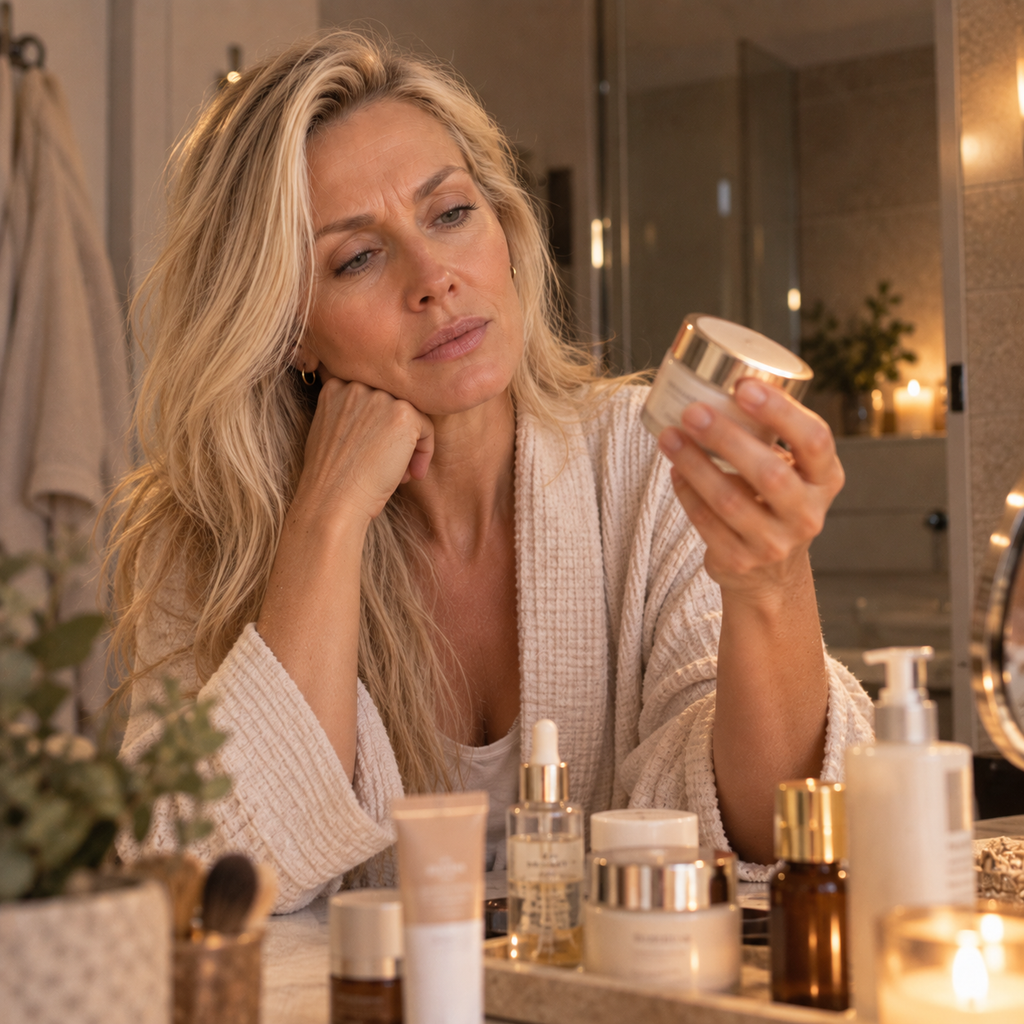
Collagen is a protein. Your body makes it. It is basically the structure that holds everything together — your skin, your joints, your bones, the walls of your blood vessels.
Think of it like scaffolding inside your body. When there is plenty of it, your skin looks full and bouncy. Your joints move easily. Your hair feels thick. When it starts to break down, you feel it. Skin gets thinner. Lines deepen. Joints get achy. Things just feel less… solid.
Your body has different types of collagen and each one does a different job.
Type 1 is the most abundant. It is in your skin, hair, nails, and bones. This is the one women notice the most when it starts to drop.
Type 2 is mostly in your cartilage. If your knees have been talking back to you lately, this one is involved.
Type 3 works alongside Type 1. It keeps skin elastic and supports organs. You lose this one at the same pace as Type 1.
You do not need to memorize all of that. The point is — collagen is not just a beauty thing. It is a whole body thing.
Here is when the loss starts (and it is earlier than you think)

This is the part that surprised me.
Collagen production starts declining at around 25. Not 50. Twenty five.
After that, you lose roughly 1% per year. So by the time you hit 50, you have already lost about 25% of what you had in your 20s.
Then menopause hits. And the loss speeds up fast. In the first five years after menopause, women can lose another 30% of their skin collagen. That is why the changes after 50 can feel so sudden. It is not sudden. It is decades of slow loss, then a sharp drop.
When I understood that timeline, I stopped being angry at my skin. It was doing its best with what it had.
What speeds the loss up

Some things destroy collagen faster. And I was doing most of them without knowing.
Sun exposure is the biggest one. UV light breaks down collagen directly. This is not a scare tactic — dermatologists consistently say that up to 80% of visible skin aging comes from sun damage. Not age, not genetics. Sun. Daily SPF is the single most protective thing you can do, even on cloudy days, even in winter.
Sugar. High blood sugar triggers a process called glycation, where sugar molecules attach to collagen fibers and make them stiff and brittle. The more sugar in your diet, the faster your collagen breaks down.
Smoking destroys collagen. Even if you quit years ago, the damage was happening in real time back then.
Stress. Cortisol, the stress hormone, actively breaks down collagen. Chronic stress, the kind that does not switch off, is doing quiet damage to your skin and joints over time.
Poor sleep. Most collagen repair happens at night. Cutting sleep short means cutting that repair process short.
What actually supports collagen production

Your body can still make collagen at 56. It just needs the right conditions.
Vitamin C is non-negotiable. Your body cannot produce collagen without it. Not some of it — none of it. The whole process depends on vitamin C being present. Citrus, bell peppers, strawberries, broccoli. Or a good supplement. Either works.
Protein matters more than most women realize. Collagen is made from amino acids, and amino acids come from protein. If you are not eating enough protein — and most women over 50 are not — your body does not have the raw materials to make collagen even if it wants to.
Glycine specifically is an amino acid that is a direct building block for collagen. Bone broth has a lot of it. So do eggs.
Retinol, used on the skin at night, is one of the most studied ingredients for stimulating collagen production. It works. Start low, use it two or three nights a week, and build up slowly.
And then there is something I learned about more recently that I think is worth knowing.
Your collagen production is connected to your cellular energy. Specifically to a molecule called NAD+ that powers the repair processes inside your cells. As NAD+ drops with age, your skin cells lose the energy they need to make and repair collagen properly.
NMN is a compound that supports your body’s NAD+ production. It does not add collagen directly. But it gives your cells more of the energy they need to do the repair work themselves. I started taking it as part of my morning routine and noticed changes in my skin texture within about a month. Not dramatic. Just more of that plumpness I had been missing.
If you want to look into it, I have linked what I take here. It is just something worth knowing about if you are serious about your skin from the inside out.
The thing about collagen creams
I want to come back to where I started. The creams.
Here is the problem with applying collagen to your skin. Collagen molecules are too large to pass through the skin barrier. They sit on top. They can hydrate and temporarily plump, which is why your skin feels nice after using them. But they are not adding collagen to your skin. They can not do that from the outside.
What works is supporting your body’s ability to make its own collagen. Vitamin C, protein, sleep, SPF, stress management, and giving your cells the energy they need to actually do the repair work.
That is the inside-out approach. And it is the only one that actually changes anything long term.
Start with SPF tomorrow morning if you do not use it already. That alone will slow collagen loss more than almost anything else you can do today.